


मुख्य जानकारी
- Hedera CPO Nilmini Rubin called for cryptographic identity and spending controls around AI payments.
- Verifiable Compute creates cryptographic evidence that can support oversight of autonomous AI systems.
- Rubin identified predictable fees and deterministic finality as requirements for institutional agentic payments.
Hedera Chief Policy Officer Nilmini Rubin outlined governance requirements for autonomous AI payments as software agents gain greater authority over financial transactions.
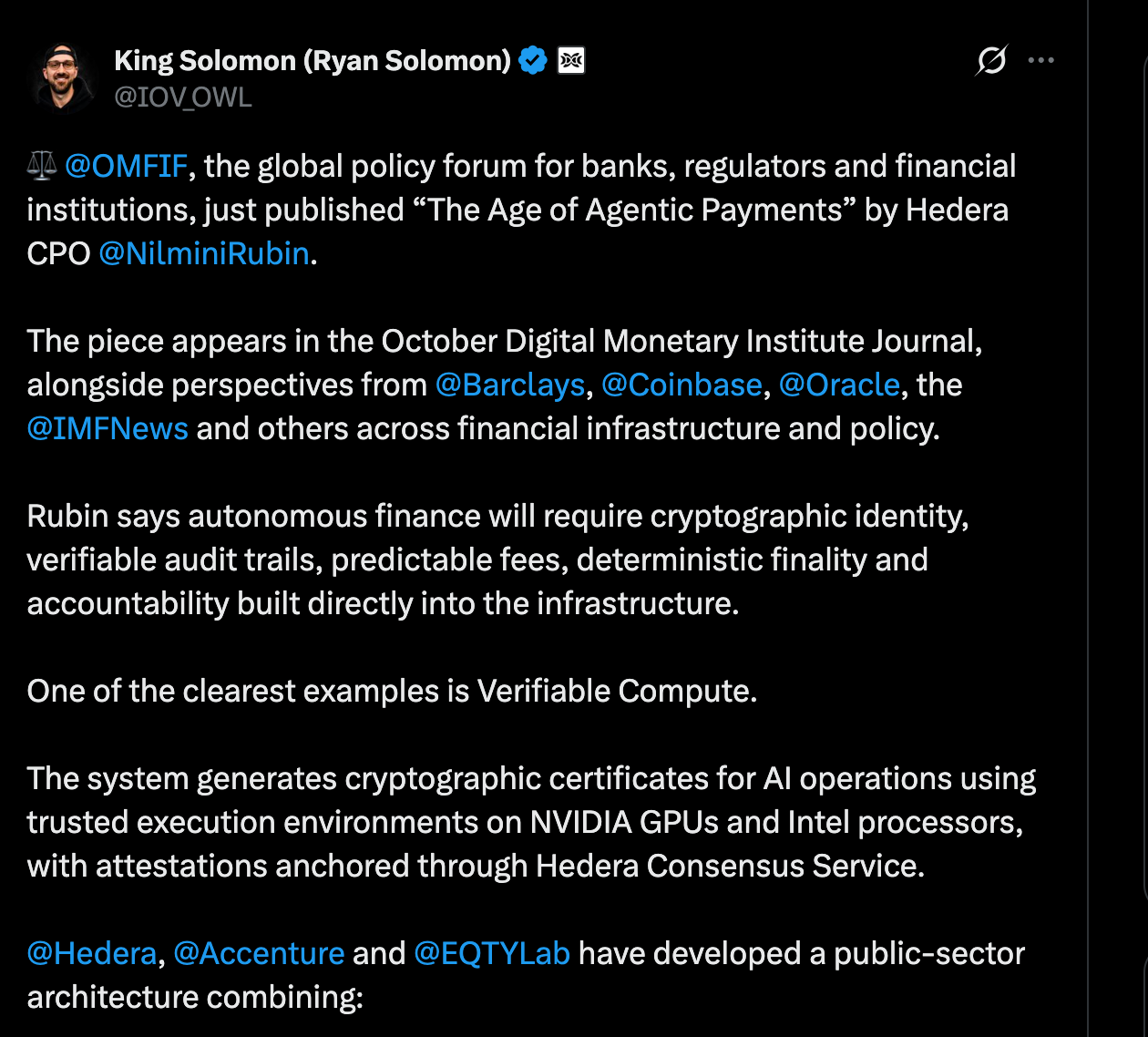
Writing in OMFIF’s October Digital Monetary Institute Journal, Rubin focused on cryptographic identity, verifiable audit trails, predictable transaction costs and deterministic finality.
Her argument centered on accountability. Financial institutions still require evidence showing who authorized a transaction even when software executes it independently.
Hedera CPO Details Identity and Spending Controls
The Hedera CPO placed authorization at the center of that framework, alongside evidence showing what an agent actually did.
Traditional know-your-customer checks assume a person conducts the transaction. However, AI agents can create payment accounts at scale and act for several principals across jurisdictions.
To address that gap, she proposed cryptographic identity standards linking agents to the people or institutions behind them.
Institutions should require proof of authorization and clearly defined operating limits, she wrote. Those requirements would preserve accountability even when nobody approves an individual payment.
The Hedera CPO also described graduated controls that distinguish transactions requiring human approval from those permitted to proceed autonomously.
Smart contracts could enact spending limits and other norms for autonomous transactions. Under that approach, authorization would establish the boundaries within which an agent could operate.
Verifiable Records Connect AI Actions With Oversight
Alongside identity checks, Rubin emphasized the need to document exactly what agents did after receiving authorization.
She cited EQTY Lab’s Verifiable Compute as an example of infrastructure designed to provide that evidence. The system generates cryptographic certificates for AI operations using NVIDIA and Intel hardware.
The system uses trusted execution environments, with attestations anchored through Hedera Consensus Service.
Hedera, Accenture, and EQTY Lab have also developed a public-sector architecture incorporating this technology.
That architecture combines Verifiable Compute, Accenture’s multi-agent gateway, NVIDIA DGX Cloud, and Hedera Consensus Service.
Rubin wrote that Verifiable Compute has already supported government oversight of agentic systems across public safety and critical infrastructure.
The architecture aims to create tamper-resistant records of agent actions. In her account, transaction infrastructure also supports verification and governance of the agents initiating those transactions.
Payment Infrastructure Faces Fee and Settlement Requirements
Beyond oversight, Hedare CPO identified operational requirements for systems processing autonomous payments.
She argued that agents need fixed, predictable fees because percentage-based pricing complicates high-volume payments for individual requests.
She also called for deterministic finality, which establishes transaction completion without probabilistic confirmation.
The Hedera CPO linked those requirements to infrastructure neutrality, warning that proprietary systems can encourage rent-seeking.
Distributed ledgers, she wrote, can settle payments while recording actions and preserving data provenance. They can also encode operating rules and record the authority supporting an agent’s decisions.
Rubin pointed to x402, a protocol allowing agents to pay automatically for data and services without account setup or approval.
Hedera integrated the protocol into its agent kit as an early adopter. Her article also identified Google, Visa, Amazon Web Services and Anthropic as supporters.
She distinguished payment options within that developing framework, including stablecoins and tokenized deposits. Tokenized deposits give regulated banks access to programmable money within existing supervision, she wrote.
This article is for informational purposes only and does not constitute financial or investment advice. Agentic payment technologies, governance frameworks and distributed-ledger systems remain subject to technical, regulatory and adoption risks.
पोस्ट Hedera CPO Outlines Trust Requirements Behind AI-Driven Payments पहली बार प्रकाशित हुई द कॉइन रिपब्लिक.




 Rupam Roy