
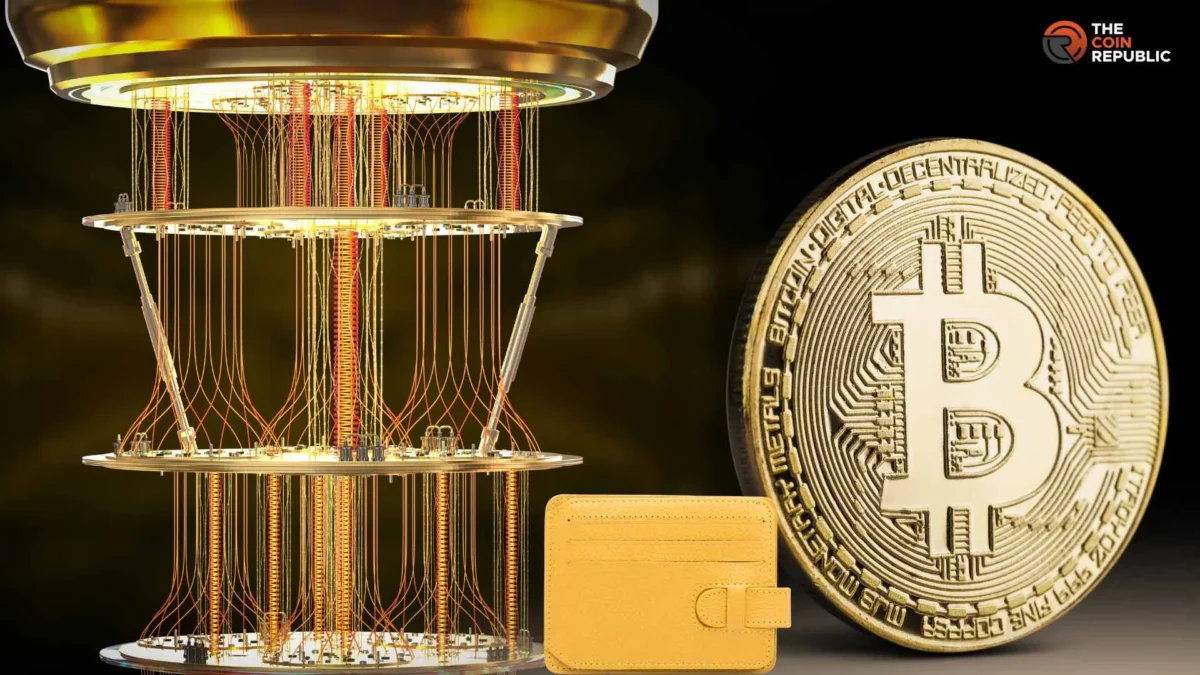

Principali approfondimenti:
- Bitcoin news: European supervisory authorities warned that quantum computing could weaken cryptography security.
- CryptoQuant estimates 6.9 million BTC in legacy wallets face future quantum exposure.
- IBM expects quantum computing to reach commercial use within four years or less.
Bitcoin News today centers on a quantum computing warning from the European Union’s three financial supervisors. The authorities said advances in quantum computing could weaken cryptography used across communications, transactions, databases, and blockchains.
However, the EU assessment did not say a quantum computer can break Bitcoin cryptography today. Instead, the agencies described a forward-looking risk tied to rising quantum capabilities. This Bitcoin News report draws on the Joint Committee of the European Banking Authority and its two counterparts. They are the European Insurance and Occupational Pensions Authority and the European Securities and Markets Authority.
EU News Center on Quantum Alert
Le European Supervisory Authorities’ update said quantum systems could optimize financial processes, fraud checks, compliance work, pricing, and simulations. However, the update also identified quantum computing as a threat to cryptography. It said the technology could weaken safeguards protecting communications, transactions, databases, and blockchains.
Meanwhile, the risk update described harvest-now-decrypt-later attacks. Attackers can now collect encrypted information and seek to read it once quantum systems can decrypt it. The European Commission said data with long-term value may already face this risk. Therefore, encryption theft does not require immediate decryption to create a future exposure.
Accordingly, the assessment stated that the Digital Operational Resilience Act requires financial entities to adopt state-of-the-art cryptography to address emerging threats. The European Commission’s post-quantum roadmap calls on member states to begin transitions by the end of 2026. It sets a 2030 deadline for high-risk use cases. The timeline leaves about three months before the first EU target.
Legacy Wallets Hold Bitcoin’s Specific Exposure
That broader warning leads to Bitcoin’s distinct exposure. Bitcoin’s security relies on cryptography that classical computers cannot feasibly break. Ki Young Ju, founder of CryptoQuant, ha detto a sufficiently capable quantum machine could derive private keys from exposed public keys. Once a public key appears on-chain, Ju said its exposure does not expire.
Notably, Ju estimated that 6.89 million BTC have potential quantum exposure. His estimate included 1.91 million BTC in P2PK addresses, where public keys are inherently visible. It also included up to 4.98 million BTC with possible exposure after earlier spending transactions.
The Bitcoin news report also notes that Ju identified 3.4 million BTC dormant for more than ten years.

That figure included roughly one million BTC linked to Bitcoin creator Satoshi Nakamoto. Ju said an upgrade could require owners of exposed coins to move them before any capable attack. He also said changing signature protections would require network-wide consensus.
Bitcoin News Links EU Timing to Bitcoin Governance
The EU news warning, therefore, places timing beside Bitcoin’s governance requirements. It does not state that an attack-capable quantum computer currently exists. However, the supervisors said a cryptographic threat could arrive before quantum systems develop commercially viable applications.
Meanwhile, the EU supervisors asked market participants and supervisors to strengthen preparedness for emerging technology risks. The Commission’s roadmap sets a 2026 transition target and a 2030 deadline for high-risk systems. These EU news measures address cryptography in the financial sector, while Bitcoin changes require network agreement.
For Bitcoin, Ju described consensus as a separate requirement. He cited the block-size dispute, which lasted more than three years and led to hard forks. He also cited SegWit2x, which did not gain sufficient community backing. Ju said social consensus can move more slowly than technology.
Separately, Ju raised the possibility of freezing dormant coins, including addresses linked to Satoshi, during a quantum upgrade. He said that approach could divide the Bitcoin community and create competing forks. The potential actions concern legacy addresses and exposed public keys, not a known quantum breach today.
This article is for informational purposes only and does not constitute financial, cybersecurity or investment advice. Quantum-computing timelines and Bitcoin exposure estimates remain uncertain.
L'articolo Bitcoin News: EU Warns Quantum Risk Could Hit Bitcoin Security è apparso per primo su The Coin Republic.




 Rupam Roy
 Glory Kaburu